
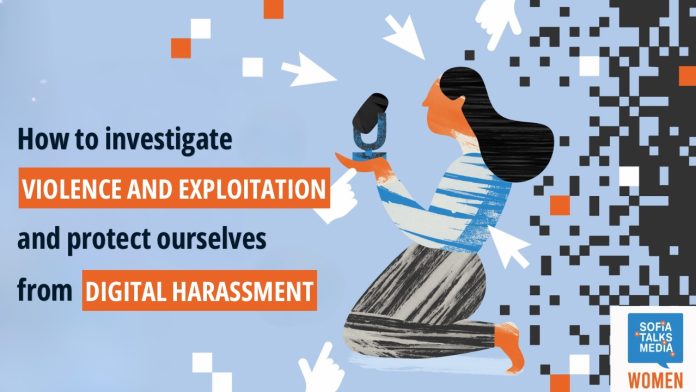
Gender-based violence, sexual exploitation and harassment are increasingly moving into the digital space. This creates significant opportunities for journalists to investigate and expose these problems, but doing so requires an understanding of the methods, channels and risks of the digital ecosystem. At the same time, journalists’ growing reliance on major technology platforms, their use of artificial intelligence and their presence on social media expose them to widespread online harassment, particularly women in the profession.
That is why, in partnership with the European Federation of Journalists (EFJ), we are organising a one-day training session on investigating online violence and exploitation, as well as tools and methods for protection against online harassment. The training is exclusively for women journalists because of the gender-specific aspects of the problem. It is part of AEJ-Bulgaria’s initiative to support women in journalism and build a network of mutual support.
With the help of leading professionals in the field—Czech investigative journalist Apolena Rychlikova and French digital safety expert Elodie Vialle—we will explore violence in all its dimensions: how we investigate it through journalism, how we write about and cover high-risk cases, how we protect ourselves from threats in the digital space, and what protection European regulations and digital policies offer. At the end of the day, media researcher Nikoleta Daskalova will summarise the cases shared by participants during the training and focus the discussion on the everyday risks faced by women journalists in Bulgaria.
The workshop will take place on 22 October, from 9:30 to 17:30 in Sofia. Participation is free, but places are limited. Please register using this form by 15 October, after which you will receive confirmation of your participation. Interpretation from English will be provided.
Programme
10:00–12:00 How Do We Investigate Violence and Protect Ourselves from It?
Trainer: Apolena Rychlikova
The training focuses on reporting methods for uncovering exploitation hidden behind anonymous profiles, closed networks and seemingly legitimate online businesses. It draws on Apolena Rychlikova’s practical experience from several major international investigations, with a focus on From OnlyFans to OnlyScams, which exposes an online pimping scheme and prompts legislative changes to better protect victims online.
Highlights:
- Accessing and verifying data in anonymous and insecure environments.
- Documenting and preserving digital evidence.
- Approaching victims sensitively without exposing them to additional risk, and respecting ethical and psychological boundaries when investigating extreme violence.
- Comparative analysis of commercial operations using contracts and anonymous malicious networks.
- Practical discussion and examination of cases proposed by participants.
13:00–16:00 Journalism and EU Digital Policies: Online Safety and the Role of Major Technology Companies
Trainer: Elodie Vialle
This training explores how journalists, who increasingly rely on Big Tech’s digital infrastructure, can use European legislation to protect themselves from online harassment and hold platforms accountable. The workshop centres on the Digital Services Act (DSA), the European Media Freedom Act (EMFA) and the mechanisms they provide.
Highlights:
- Journalists, Big Tech and online threats: why platform accountability is crucial to media safety.
- EU digital policy and Big Tech accountability: a practical introduction to the DSA, EMFA and related regulations. An analysis of how journalists’ organisations and trade unions can use them for protection, including specific cases, court rulings and initial successes.
- From attack to response: putting regulation into practice. Building a practical framework for addressing online harassment: detection, documentation, risk assessment, reporting and identifying escalation routes.
- Case mapping. Applying the methodology to a specific incident (identification, risks, platform policies and regulatory measures).
- Discussion of how the framework can be applied beyond cases of online harassment.
16:30–17:30 Discussion: “Safe and Protected at Work: The Experiences of Bulgarian Women Journalists”
Moderator: Nikoleta Daskalova
A conversation about the specific risks and harassment faced by women journalists in their everyday work in Bulgaria—in the field, online and in the newsroom. We will discuss how reporting on abuses makes journalists targets and what practical response mechanisms are available in situations of insecurity.
About the Trainers:
Apolena Rychlikova
Journalist, documentary filmmaker and editor-in-chief of Page Not Found, Czechia
 Apolena Rychlikova is an award-winning investigative journalist and documentary filmmaker, as well as co-founder and editor-in-chief of the independent Czech media outlet Page Not Found. Her work focuses on online exploitation, sexual violence, digital platforms, influencers, radicalisation, and the ways technology reshapes power and vulnerability. Her reporting has been published by or produced in collaboration with outlets such as The Guardian, European Correspondent, BIRN, OCCRP, CNN and Foreign Policy. She has also written and directed several documentary films, including Limits of Work and The Limits of Europe.
Elodie Vialle
 Elodie Vialle is a journalist, digital policy adviser and digital safety trainer. She has more than ten years of experience supporting journalists and newsrooms facing digital threats. She has held fellowships at Harvard University’s Berkman Klein Center and Institute for Rebooting Social Media, as well as a Knight-Wallace Fellowship at the University of Michigan. In 2025, Vialle authored the report Ending the Silence on Online Harassment of Journalists for the European Federation of Journalists (EFJ), which includes the first technology policy guide of its kind for European trade unions.
Nikoleta Daskalova
 Media researcher, co-author of the study “Being a Journalist: The State of the Profession” (2017) and author of “Being a Woman Journalist: The Cost of the Profession” (2026).
Funded by the European Union as part of the IMPACT project led by the European Federation of Journalists (EFJ). Views and opinions expressed are however those of the author(s) only and do not necessarily reflect those of the European Union or European Education and Culture Executive Agency (EACEA). Neither the European Union nor EACEA can be held responsible for them.